- All
- Wisdom
- We Stand on Their Shoulders
- Vocation
- Uncategorized
- Stories Seldom Heard
- Spirituality
- Social Justice
- Prayer
- Peace
- Oneness
- Love
- Letting Go
- Lent
- Joy
- Inspirational Images
- Hope / Healing
- Holy Week
- Gratefulness
- God's Presence
- General News Stories
- Forgiveness
- Finding God
- Faith
- Easter
- Dominican Saints
- Discipleship
- Courage
- Christmas
- Catholic Sisters Week
- Care of the Earth
- Blessing
- Beauty
- Advent
- #justiceOPportunity
Be patient toward all that is unsolved in your heart
Sr. Patricia Bruno, OP
317th Edition
December 2025
Be patient toward all that is unsolved in your heart
and try to love the questions themselves….
Perhaps you will gradually,
without noticing it, live along some distant day
into the answer (1).
Yesterday was the First Sunday of Advent. We are beginning to feel the unique spirit of this season. Advent is an “in–between” time. With the change of weather, we are acutely aware that the chill of winter has only begun. Advent is also a season of mystery: a time of grace interlaced with suffering and injustice, all of which are held by Divine Love. In this “in–between” time, between the promised arrival and the arrival of the Promised One, we wait without answers, and we wait with hope.
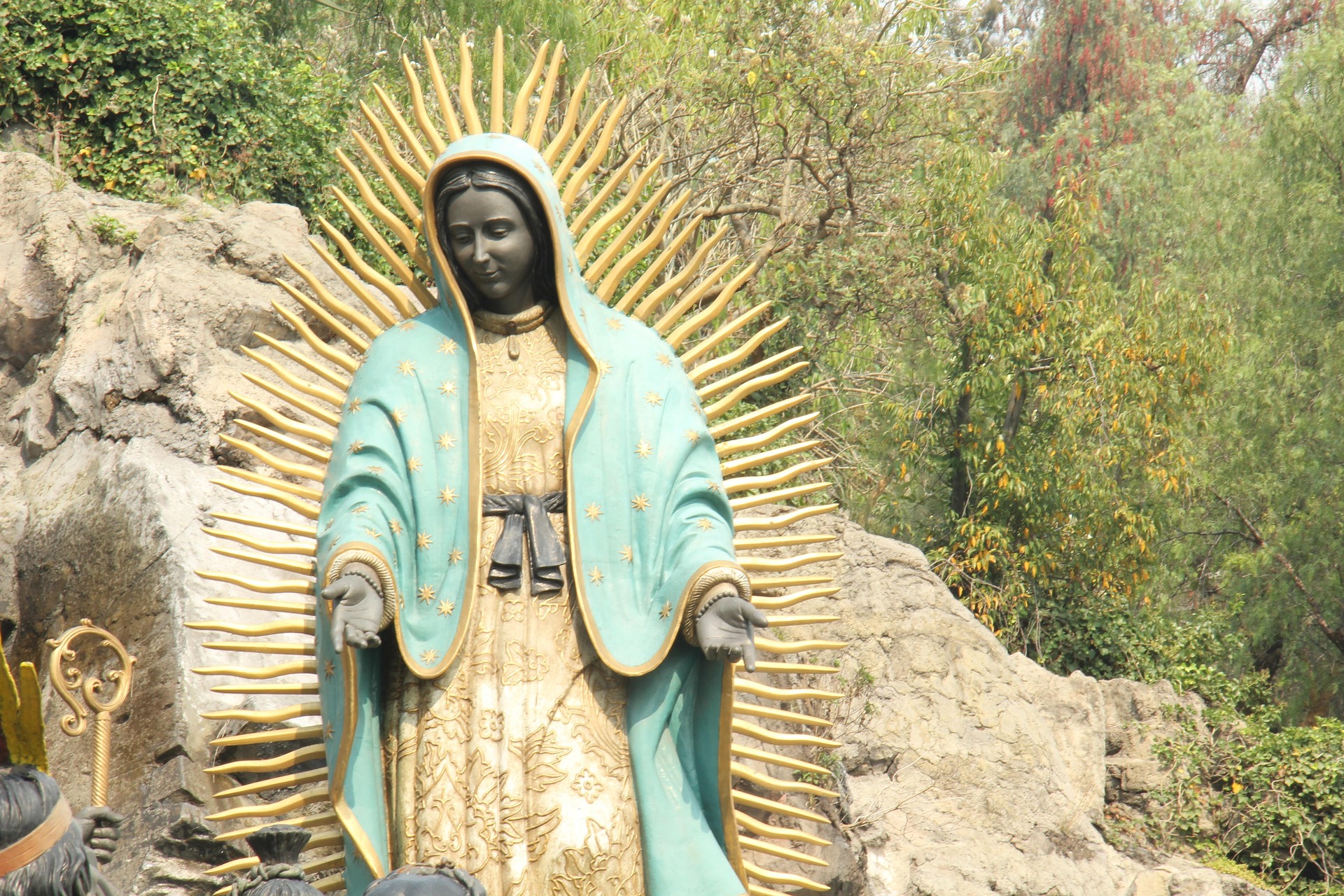
Along the Advent road, many voices help prepare us for our Christmas celebration: a unique and wonder-filled Christ event. There are many saints whose stories are “seldom heard” and whose lives help direct our prayers and actions during these days of anticipation. Two feasts stand out especially as we gaze towards the Christmas crib. On December 8th, we celebrate the Immaculate Conception. On December 12th, we celebrate Our Lady of Guadalupe. It is the latter feast on which I would like to reflect.
Sometimes we think of Our Lady of Guadalupe’s apparitions and message as a gift only for another culture, but in truth, her apparitions have had a profound effect on the religious history of all the peoples of the Americas. Through the words of Our Lady of Guadalupe, God’s Christ message was heard loud and clear in the hearts of the Nahuatl people, as well as in the 16th-century Spanish and religious courts. Before the apparitions and the building of the “Hermitage” (the church), the Spaniards imposed their Christian religion on the native Aztec people, but within six years after the apparitions, over nine million Aztecs freely chose to be baptized. It is these apparitions that marked “the birth of the Mexican people – the fusion between the Spanish and the indigenous races and cultures” (2).
The time is 1531. The place is a small hill outside what is now called Mexico City. Juan Diego, a Christian native, is on his way to Mass. On his way, he passes by the hill at Tepeya,c where he hears a feminine voice calling his name. The young, native woman tells Juan to go to the bishop and request that a hermitage be built in her honor on the hill. It’s hard to imagine how astonished and frightened Juan Diego must have been. Hearing an unknown native woman calling him by name was surprising enough, but her requests must have felt outrageous. How could he, a lowly native, request a meeting with the bishop? Under whose authority could he request the construction of a hermitage: a home for the homeless, a shelter for orphans, and a hospice for the traveler? Juan might have had difficulty doing what the Lady asked, but he clearly understood her requests because she spoke to him in his native tongue, Nahuatl. Still, Juan Diego pleaded with her.
My dear Lady…This I beg you, entrust your mission to one of the important persons who is well known, respected, and esteemed so that they may believe him. You know that I am nobody, a nothing, a coward, a pile of old sticks….You have sent me to walk in places I do not belong. Forgive me, and please do not be angry with me, My Lady and Mistress” (3).
Even though it was risky, the Lady’s request was delivered by Juan, but not without great effort and a few major obstacles. When Juan arrived at his destination, the bishop’s court, no one paid attention to his request to see the bishop because Juan was considered “a nobody…a pile of sticks.” After waiting a long time, Juan finally got an appointment with the bishop, who found Juan’s message incredible. “My son, you will have to come another time”(4). Juan returned two more times before the bishop honored the Lady’s request. The sign that convinced the bishop is now well known. Juan unfolded his white mantle in which he held the exquisite and unusual flowers that grew in the desert hilltop of Tepeyac. The flowers in his mantle created the image that is now well recognized as Our Lady of Guadalupe. Her native features mirrored those of the Nahuatl people.
The story of Juan Diego and “Our” Lady of Guadalupe is a complex and beautiful story. Every part of the story is carefully and poetically crafted to remind the poor, the outcast, and the oppressed, and us of the universality of God’s love. Her presence and requests remind us that no one is a “no-body, a nothing, a pile of old sticks.” At a time when the native people were oppressed, and in a world where their culture had been decimated and the achievements of their advanced civilization destroyed or ignored, this Holy Mother offered the indigenous people hope and dignity.
The story of Our Lady of Guadalupe raises uncomfortable questions for those in power then and now. Like Jesus and the prophets of old who condemned people who exploited the poor and the defenseless, Our Lady’s message confronted the self-righteous leadership in the government, the church, and society. Her voice is powerful and travels through the centuries. Her message reaches beyond the structures and people of her time to touch each of us. Advent is a time to be aware of our “blindness.” It’s a time to see with the eyes of God and to respond to those who are in any way oppressed, marginalized or dehumanized by our attitudes or institutions. This is the season to become more aware of the One who became one with us. It is a time to celebrate God’s incredible, unconditional love for us that stretches beyond cultures, customs, religion, and human-made boundaries. ‘Tis the season to be attentive and to incarnate in our lives Christ’s unconditional love.
We not only hear, in a woman’s voice, God’s desire for us, but we also hear her requests today. Are we willing to address the issues of discrimination and injustice in our society as Juan Diego did? Are we willing to visit our bishops and our elected officials to speak on behalf of those whose rights are being violated? How can we, in this Advent season, protect and comfort those who are attacked because of the color of their skin or their faith? What can we do in our homes, neighborhoods, schools, and workplaces to recognize, appreciat,e and celebrate our common humanity? Juan Diego might have felt as though he was a “pile of old sticks,” but Our Lady of Guadalupe’s words enkindled within him a fire that still blazes today in the hearts of those who love God and speak on behalf of the oppressed.
1. The Book of Hours: Love Poems to God, Rainer Maria Rilke, translated by Anita Barrows and Joanna Macy, Riverhead Books, New York, 1996
2. All Saints, edited by Robert Ellsberg, A Crossroad Book, New York. 1997, p.537
3. Guadalupe: Mother of the New Creation, Virgil Elizando, Orbis Books, Maryknoll, New York, 1997
3. Robert Ellsberg, p. 537
4. ibid
Special thanks to Mary Ellen Green and Maria Hetherton who have helped in editing this article. Also, special thanks to Bob McGrath who conscien-tiously mails SSH to you each month. Without Bob’s generosity this service would not be possible. Bob utilizes Constant Contact for mailing. If you wish to change your email address please send your new email address to Bob at robert.mcgrath@mgrc.com. Thank you.
“Stories Seldom Heard” is a monthly article written by Sister Patricia Bru-no, O.P. Sister is a Dominican Sister of San Rafael, California. This ser-vice is offered to the Christian Community to enrich one’s personal and spir-itual life. The articles can be used for individual or group reflection. If you would like “Stories Seldom Heard” sent to a friend, please send a note to Sister Patricia at brunoop2017@gmail.com.
If you would like to support this ministry, please send a donation to Domin-ican Sisters of San Rafael, and Mail it to Sister Patricia Bruno, O.P.,
40 Locust Avenue, San Rafael, CA 94901. Thank you.